Updated: July 2026
Sumba vs Bali Honeymoon: Which is Best for Luxury Travelers?
- Choose Bali for: Vibrant social scenes, extensive five-star resorts, and sophisticated spa and culinary options.
- Choose Sumba for: Untouched landscapes, ultimate seclusion in world-renowned private estates, and authentic cultural encounters.
- The Deciding Factor: Prioritize polished variety (Bali) or raw, exclusive adventure (Sumba).
The air shifts the moment you step off the plane. In one reality, it’s thick with the scent of frangipani and clove-scented kretek smoke, a hum of scooters and gamelan music just beyond the airport walls. In another, the air is dry, clean, carrying the scent of sandalwood and scorched earth, the sound a vast and profound quiet broken only by the distant whinny of a horse. This is the immediate, sensory choice a luxury traveler faces when considering a Sumba vs Bali honeymoon. One is an island you think you know, a global icon of tropical escape. The other is an island that knows itself, a place of ancient spirits and untamed horizons, waiting to be discovered. As editors who have spent decades charting the evolution of luxury travel in Indonesia, we’ve seen the desires of discerning couples shift from the merely beautiful to the truly meaningful. The question is no longer just “where,” but “why.”
The Landscape: Polished Paradise vs. Untamed Majesty
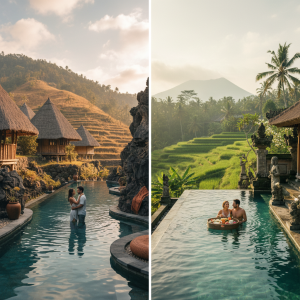
The fundamental difference between these two Indonesian isles is etched into their very topography. Bali is an island of meticulous, almost theatrical, beauty. Its landscapes feel curated, from the emerald green rice terraces of Tegalalang, engineered over centuries and now a UNESCO World Heritage site, to the volcanic black sand beaches of the eastern coast, framed by perfectly positioned palm trees. It’s an island of contained beauty, where nature has been shaped and perfected for human enjoyment. The drive from Seminyak to Ubud, a distance of only about 35 kilometers, reveals a dense mix of villages, temples, and galleries. It is lush, vibrant, and palpably populated by its 4.3 million residents.
Sumba, by contrast, is a canvas of raw, elemental power. At 11,052 square kilometers, it is more than double the size of Bali but home to a mere fraction of its population—fewer than 800,000 people. This vast emptiness is the island’s defining characteristic. The landscape is dominated not by volcanoes and jungles, but by rolling, grassy savannas that evoke the African plains, punctuated by low-lying forests and dramatic limestone plateaus. Its coastline is a series of powerful, uncrowded beaches and staggering cliff fronts where the Indian Ocean unleashes its full force. A drive across Sumba reveals not a chain of villages, but immense, empty spaces where herds of wild horses, the island’s icon, roam free. The sense of scale here is humbling. You can drive for an hour and see nothing but undulating hills meeting a turquoise sea. This is not a landscape designed for postcards; it is a landscape that commands respect and inspires a sense of profound solitude, a core component of any true sumba honeymoon experience.
The Luxury Resort Experience: A Tale of Two Philosophies
In Bali, the luxury hotel scene is a mature and dazzlingly diverse ecosystem. Here you will find the flagships of nearly every major five-star brand on earth: Four Seasons, Ritz-Carlton Reserve, St. Regis, Bulgari, Como. These properties are masters of a certain kind of polished, service-driven luxury. They offer expansive suites, multiple swimming pools, award-winning spas, and a roster of acclaimed restaurants, all within a single, immaculately manicured compound. A honeymoon at a top Balinese resort is about having every conceivable amenity at your fingertips. You can start your day with a private yoga session overlooking the Ayung River, indulge in a five-hour spa ritual, and conclude with a tasting menu crafted by a Michelin-pedigreed chef. The luxury is comprehensive and accessible, a well-oiled machine of sophisticated hospitality. There are over 150 five-star hotels on the island, creating a competitive market that ensures service standards remain exceptionally high.
Sumba’s approach to luxury is entirely different. It is a philosophy of radical exclusivity and intentional isolation. The island is anchored by a small handful of world-renowned properties, most notably NIHI Sumba, a resort that has redefined the concept of “wild luxury.” Spread across 567 acres of pristine coastal land, NIHI’s 28 private villas offer a level of privacy that is simply unattainable in Bali. The experience is not about an abundance of choice within a resort, but about the exclusive access the resort provides to the island itself. This includes private access to “Occy’s Left,” one of the world’s most coveted surf breaks, with a strict cap of just 10 surfers per day. Luxury here is measured in space, silence, and unique, unscripted moments—a private guide leading you to a hidden waterfall, a sunrise horseback ride along an empty two-and-a-half-kilometer beach, or a spa safari to a secluded clifftop bale. When we at the Sumba Honeymoon Atelier design itineraries, we focus on this philosophy: luxury as a gateway to profound, personal discovery rather than just opulent comfort.
Culture and Connection: Ancient Rituals vs. Spiritual Wellness
Both islands offer deep cultural wells, but the way a visitor engages with them is starkly different. Balinese culture, a unique form of Hinduism, is visible and performative. It’s in the daily canang sari offerings placed on every doorstep, the hypnotic cadence of a Kecak fire dance at Uluwatu Temple, and the island-wide celebrations for holidays like Galungan. For the honeymooner, this culture is highly accessible. You can easily book a temple tour, participate in a water purification ceremony, or visit the artisan villages around Ubud. The island has become a global hub for spiritual wellness, with thousands of yoga studios, meditation centers, and holistic healers. It offers a structured path to spiritual exploration, one that is welcoming and easily integrated into a luxury travel itinerary. The experience is enriching and beautiful, but it is often a curated one, presented for an international audience.
Sumba’s culture is more ancient, enigmatic, and deeply embedded in the land. The majority of the Sumbanese people practice Marapu, an animistic religion that venerates ancestors and the spirits of nature. This belief system is not a performance for tourists; it is the living, breathing heart of the island. It manifests in the striking, high-peaked traditional houses, the intricate ikat weavings that tell ancestral stories, and the immense megalithic tombs that still dot the landscape. The most dramatic expression of Marapu culture is the Pasola festival, a ritual battle between two teams of spear-wielding horsemen held annually in February or March. Witnessing Pasola is not a comfortable or planned itinerary; it is a raw, visceral, and sometimes violent spectacle intended to appease the spirits and ensure a bountiful harvest. Engaging with Sumbanese culture requires a deeper commitment and often the guidance of a trusted local expert. It’s less about observing and more about being granted a rare glimpse into a timeless way of life, a key part of what makes a sumba honeymoon so transformative.
Activities and Adventures: Curated Excursions vs. Raw Exploration
When considering the day-to-day activities on a Sumba vs Bali honeymoon, the theme of polish versus raw continues. Bali is a master of the curated luxury experience. Your hotel concierge can arrange virtually anything with a single phone call: a private helicopter tour over Mount Batur, a Dom Pérignon-fueled catamaran cruise to Nusa Lembongan, a hands-on silver-making class with a master artisan in Celuk, or a private cooking lesson focusing on modern Balinese gastronomy. The island’s infrastructure is built to support a high volume of tourism, meaning activities are plentiful, professional, and easily booked. The adventure is in the variety and quality of the experiences on offer, allowing you to craft a honeymoon that is as relaxed or as action-packed as you wish.
Sumba offers adventure of a different sort. It is less about a menu of options and more about exploration. The island’s greatest luxuries are its undeveloped spaces, and the best activities involve immersing yourself in them. Instead of a helicopter tour, you might take a rugged 4×4 journey through the hills to discover the striking Lapopu Waterfall, a 90-meter cascade hidden deep in the forest. Instead of a cooking class in a pristine demonstration kitchen, you might visit a local village market with your resort’s chef to select ingredients for a private dinner cooked over an open fire on the beach. The iconic Sumbanese experience is a sunset horseback ride along the shore, a liberating gallop on an empty expanse of sand as the sky turns crimson. These are not packaged tours but genuine expeditions. According to the official Indonesian tourism board, Sumba’s appeal lies in this “unspoiled nature.” The thrill comes from the sense of discovery, of being one of the few to witness a particular view or swim in a particular cove, an ethos that is central to the private luxury retreats we champion.
Quick FAQ: Sumba vs Bali Honeymoon
Which is more expensive for a luxury honeymoon?
While Bali has options across all price points, its top-tier luxury can be comparable to Sumba. However, Sumba’s luxury is concentrated in a few ultra-exclusive resorts where nightly rates typically start much higher, often from $1,000 to over $5,000 USD. The all-inclusive nature of many Sumba resort packages can offer value, but on a per-night basis, Sumba is generally the more significant investment.
How easy is it to travel between Sumba and Bali?
It is quite straightforward. There are multiple daily flights from Bali’s Ngurah Rai International Airport (DPS) to Sumba’s Tambolaka Airport (TMC). The flight time is typically 60 to 90 minutes. Most luxury resorts in Sumba, like NIHI, will arrange seamless airport transfers, which are often a scenic 90-minute drive through the island’s countryside.
What’s the best time of year to visit Sumba and Bali?
Both islands share a similar dry season, which is the ideal time to visit, running from roughly April to October. This period offers sunny days and less humidity. Sumba can be particularly beautiful at the end of the wet season (March/April) when its savannas are brilliantly green before they turn a golden brown in the dry months.
Is Sumba safe for honeymooners?
Absolutely. Sumba is a very safe destination, particularly when staying at one of its reputable luxury resorts. These properties have deep community ties, excellent security, and expert guides for all excursions. The island’s low population density and remoteness contribute to a peaceful and secure environment, perfect for a secluded and worry-free honeymoon.
The Final Word: Choosing Your Narrative
Ultimately, the choice between a Bali and a Sumba honeymoon is a choice between two different narratives of luxury. Bali is the perfect execution of a well-known story: the tropical paradise, perfected. It offers comfort, variety, and a vibrant energy that is undeniably seductive. It is the ideal choice for the couple who wants the world’s best at their fingertips, who thrives on social energy, and who appreciates a landscape of cultivated, accessible beauty. It is a flawless honeymoon, delivered with impeccable style.
Sumba, however, is a story you write yourself. It is a wild, unedited manuscript of an island that offers not just escape, but transformation. It is for the couple who defines luxury not by what is available, but by what is absent: the crowds, the noise, the curated artifice. It is for those who seek connection—to nature, to an ancient culture, and most importantly, to each other—in a place of profound quiet and untamed beauty. If the call of a wilder, more soulful form of luxury speaks to you, then the journey does not end with this article. It begins with designing the ultimate sumba honeymoon, an experience that promises not just a destination, but a departure from the ordinary.